CN

Company Law Committee Issue 35 | Highlights of the Revision of the New Arbitration Law and Reflections

Source:Guangdong Chenggong Law Firm
Author:Guangdong Chenggong Law Firm
13
01
undefined

35期


案例分享

Recently, the 35th professional sharing session of the Corporate Law Professional Committee of Guangdong Chenggong Law Firm was held as scheduled.


The theme of this sharing session was "Highlights of the Revision of the New Arbitration Law and Reflections". The keynote speaker, Lawyer Cheng Huanxiang, conducted an in-depth analysis of the highlights of the revision of the new arbitration law by comparing domestic and international arbitration systems and practices, and combined with his own experience in international arbitration education and handling arbitration cases, shared his thoughts on lawyer practice with all the committee members.


The sharing session was insightful and easy to understand, and all committee members engaged in lively discussions on the theme content.


undefined


On September 12, 2025, the 17th Session of the Standing Committee of the 14th National People's Congress voted to adopt the newly revised Arbitration Law of the People's Republic of China (hereinafter referred to as the New Arbitration Law or the New Law), which will come into effect on March 1, 2026.


It is understood that the current Arbitration Law (hereinafter referred to as the original Arbitration Law) has been in effect since September 1, 1995, having been implemented for over 30 years, and underwent two minor amendments in 2009 and 2017 respectively.


undefined


ONE

Four Major Features of This Revision


(1)With Chinese characteristics


1.The development of the arbitration cause implements and carries out the line, principles, policies, decisions, and arrangements of the Communist Party of China and the state, serves the country's high-quality development and high-level opening-up, creates a market-oriented, law-based, and internationalized business environment, and plays a role in resolving economic disputes.


2.Judicial administrative departments guide and supervise arbitration in accordance with the law.


(2)Integrating with international rules and actively aligning with internationally accepted rules.


1.Align with international commercial arbitration and introduce the system of "arbitral seat";


2.Introduce ad hoc arbitration and establish a parallel model of institutional arbitration and ad hoc arbitration;


3.Support international exchanges in arbitration and encourage Chinese arbitration institutions to go global;


4.Expand the scope of cases in foreign-related arbitration and enhance the ability to counter external measures.


(3)Regulation and Support


1.Clarify the names and legal nature of arbitration institutions, requiring information disclosure and transparency;


2.Regulate the qualification requirements of the composition of personnel of arbitration institutions and arbitrators (including the duty of disclosure);


3.Address practical pain points and improve arbitration procedures: Improve the preservation system and the right to collect evidence.


(4)Technology and Modernization


1.Recognize the legality and validity of online arbitration.


2.Emphasize the importance of scientific and technological talents.


 TWO

Main Highlights and Reflections on the Revision of the New Law


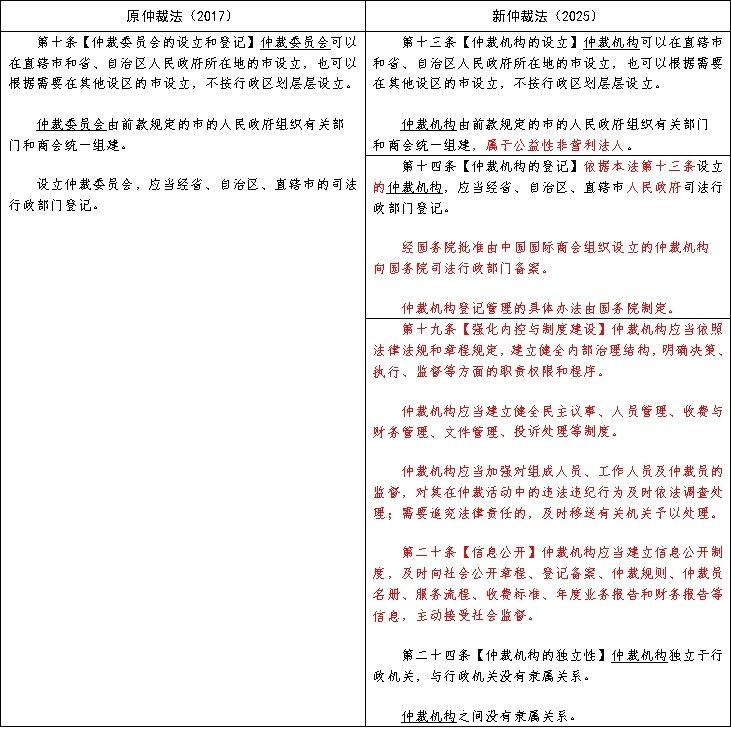
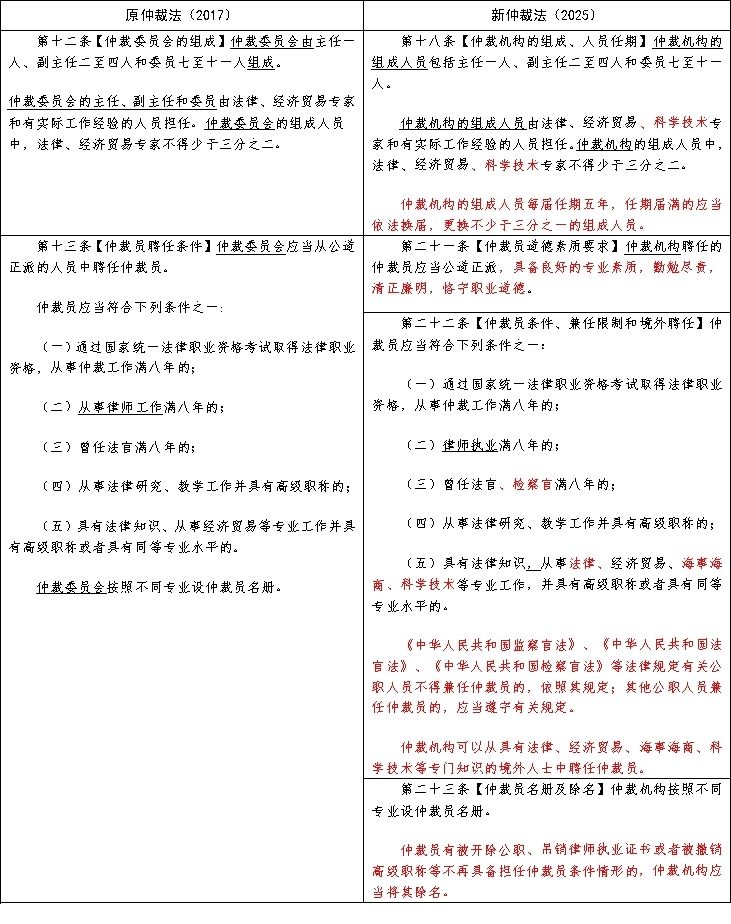
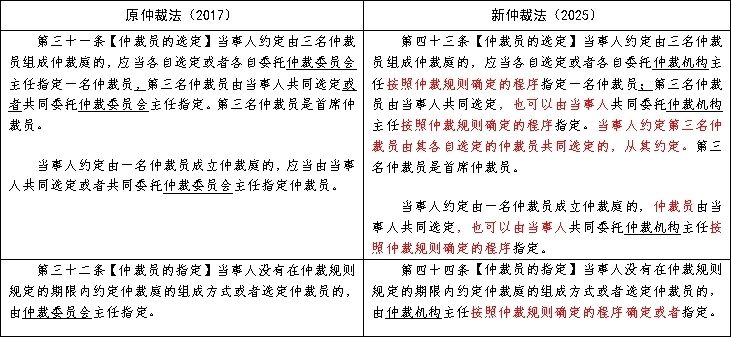
(Underline indicates parts where the expression is changed; red font indicates newly added parts; strikethrough indicates deleted parts.)


(1)Arbitration cause, arbitration institutions, arbitrators


1. Regulate the names of arbitration institutions, clarify their legal status, and optimize filing and registration management


1.1. Regulate the names of arbitration institutions and clarify their legal status


undefined


First, the new law changed "Arbitration Commission" to "arbitration institution", which is not only an optimization and standardization in terms of wording but also conforms to the development of practice. In fact, arbitration institutions across China are no longer limited to being named as "Arbitration Commissions". For example, the Beijing Arbitration Commission (Beizhong·BAC/BIAC) also uses the name "Beijing International Arbitration Court"; the Shenzhen Arbitration Commission (SCIA) is externally known as the "Shenzhen International Arbitration Court" and also as the "Guangdong-Hong Kong-Macao Greater Bay Area International Arbitration Center" and the "South China International Economic and Trade Arbitration Commission".


Therefore, in practice, when parties and lawyers choose arbitration as the method for dispute resolution, they should be particularly careful not to write the name of the arbitration institution incorrectly when drafting the arbitration agreement.


Secondly, the new law clarifies that the nature of arbitration institutions is that of public welfare non-profit legal persons, resolving the long-standing issue of "ambiguous attributes" among arbitration institutions in China. However, Article 15 of the original Arbitration Law only specified that the China Arbitration Association is a social organization legal person and that arbitration commissions are its members, but did not clarify the legal status of arbitration commissions themselves.


Regarding the nature of arbitration institutions, in the past, most arbitration institutions in China were public institutions or managed in accordance with civil service standards. Local governments, based on their own circumstances (such as funding for arbitration institutions, revenue and expenditure management methods, etc.), classified arbitration institutions as "internal organs of government functional departments" or "public institutions", among others. In December 2018, the General Offices of the CPC Central Committee and the State Council issued the Several Opinions on Improving the Arbitration System and Enhancing the Credibility of Arbitration, which proposed to "reform and improve the internal governance structure of arbitration institutions" and that "localities can explore and reform the operating mechanisms and specific management methods of arbitration commissions according to actual conditions". Since then, localities such as Shanghai, Beijing, and Guangzhou have successively launched explorations and reforms regarding the nature of arbitration institutions. Shenzhen, however, is at the forefront of arbitration development. Since 2012, the Shenzhen Court of International Arbitration (SCIA) has established a corporate governance structure centered on the council, implementing a system and mechanism reform featuring the separation and effective checks and balances of decision-making power, executive power, and supervisory power. On October 1, 2020, Shenzhen further established the SCIA as a statutory body not for profit by exercising the legislative power of special economic zones (Article 3, Paragraph 1 of the Regulations of Shenzhen Court of International Arbitration). Overall, after the reform, most arbitration institutions across the country have adopted an enterprise financial system, independently prepared financial budgets (and final accounts), and autonomously decided on financial revenues and expenditures; property and profits are not distributed to contributors or founders.


In addition, the new law puts forward higher requirements for the establishment and improvement of internal management systems of arbitration institutions, requiring them to disclose information publicly. This means that arbitration institutions need to disclose information such as their fee standards, financial reports, and other details, and accept supervision from all sectors of society. To some extent, this is also consistent with the provisions on the independence of arbitration institutions in Article 24 of the new law.


1.2. Optimize and clarify the registration and filing management of arbitration institutions


In addition to retaining the provision that arbitration institutions shall, in principle, be registered with the judicial administrative departments of provinces, autonomous regions, and municipalities directly under the central government, the new law clarifies that arbitration institutions established by the China Chamber of International Commerce with the approval of the State Council (mainly referring to CIETAC) shall file directly with the judicial administrative department of the State Council. Moreover, the new law authorizes the State Council to formulate specific measures for the registration and management of arbitration institutions, which means that subsequent supporting documents will further refine aspects such as registration conditions, procedures, and regulatory measures, helping to standardize the management of arbitration institutions nationwide.


2. Regulate the qualification requirements of the composition of personnel and arbitrators


undefined

2.1. Regulate the qualification requirements of the composition of personnel and add provisions on term of office


The new law has added the requirement for "scientific and technological experts" to the qualification requirements for the composition of personnel of arbitration institutions, and added provisions on a five-year term of office for the composition of personnel. It is believed that the content of this revision has absorbed local legislation (such as the Regulations of Shenzhen Court of International Arbitration) and rules of various arbitration institutions (such as the provision that each term of the council is five years), among others.


2.2. Regulate the qualification requirements of arbitrators


In practice, some arbitration institutions have taken the lead in making provisions on the qualification requirements and management of arbitrators. For example: ① In 2021, CIETAC's Provisions on Granting Arbitrator Qualifications stipulated circumstances for removing arbitrators. ② In September 2025, the Guangzhou Arbitration Commission issued the Regulations on the Management of Arbitrator Qualifications and the Code of Conduct for Arbitrators.


This revision emphasizes that arbitrators should possess "good professional qualities, be diligent and responsible, incorruptible and upright, and abide by professional ethics", further broadens the selection channels for arbitrators, including allowing industry professionals who have served as prosecutors for at least eight years or are engaged in specialized work such as maritime affairs, science, and technology to serve as arbitrators, and also clarifies provisions such as allowing public officials who meet legal requirements to concurrently serve as arbitrators and permitting arbitration institutions to appoint foreign nationals as arbitrators. Moreover, the new law specifies the circumstances for disqualifying arbitrators, including being dismissed from public office, having a lawyer's license revoked, or having a senior professional title revoked. This revision raises the requirements for the comprehensive qualities of arbitrators, such as moral responsibility and professional competence, emphasizes arbitrators' integrity, improves the entry and exit mechanism for arbitrators, strengthens management and supervision, which helps enhance public trust in arbitrators and ensure the impartiality of arbitration.


3. Refine the composition of the arbitral tribunal and clarify arbitrators' duty of disclosure.


undefined


The new law further refines the composition of the arbitral tribunal, specifically: it adds a new mechanism where the presiding arbitrator may be jointly selected by the arbitrators respectively chosen by both parties; it emphasizes the basis for the director of the arbitration institution to designate arbitrators, namely that they should be designated "in accordance with the procedures determined by the arbitration rules". This revision will help promote more arbitration institutions to formulate and refine more complete and well-established rules for the composition of the arbitral tribunal (previously, many arbitration institutions had already stipulated this in their arbitration rules).


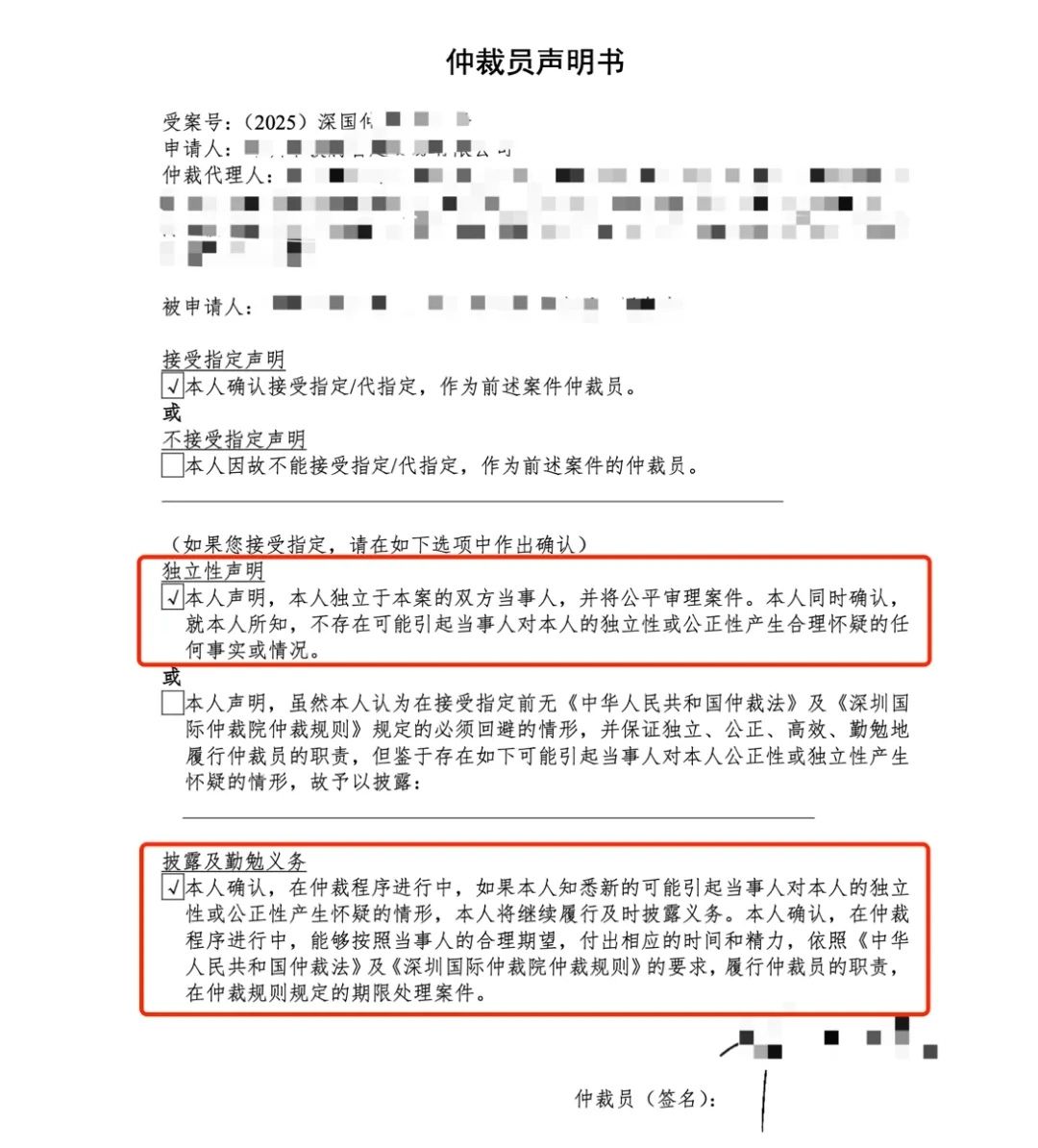
Additionally, this amendment has clarified arbitrators' duty of disclosure at the legislative level. Furthermore, in setting the disclosure standard, the new law has adopted the "reasonable doubt" standard, which is widely recognized in the practice of international and domestic arbitration.


Take an arbitration institution as an example:


undefined


 THREE

Regarding arbitration procedures


1. C


undefined


The new law formally clarifies and recognizes the legality and validity of online arbitration activities, meaning that online arbitration has equal legal effect with offline arbitration on the premise that the parties do not explicitly express disagreement (i.e., the parties are deemed to have agreed).


1.1. Online arbitration portals are convenient and efficient.


Online arbitration portals are convenient and efficient, saving time and money costs for the parties. Nowadays, especially since the COVID-19 pandemic, most major arbitration institutions have established online arbitration systems. Take the Shenzhen Court of International Arbitration (hereinafter referred to as SCIA) as an example: parties and their agents can use the cloud-based arbitration system to apply for case filing, submit and receive materials, etc. Among these, parties and their agents do not need to go to the site for case filing when applying; they can complete it directly through the online system. Service of materials can also be done via electronic data exchange methods such as SMS, WeChat, the cloud-based arbitration system, and email. For parties and agents in different locations, this greatly reduces the time and money costs of travel or mailing and improves efficiency. However, it should be noted: based on case handling experience, for cases handled by SCIA involving property preservation, paper materials should still be submitted on-site or mailed, which will be forwarded by SCIA to the competent court.


1.2. Online hearing


In fact, in addition to the aforementioned online case filing applications, material submissions, and receipts, the practice of online hearings has become increasingly common. In recent years, major domestic arbitration institutions have also explicitly incorporated the hearing method of online hearings into their arbitration rules. For example: ① Beijing: Article 25 of the Beijing Arbitration Rules stipulates, "Hearing Methods (1) The arbitral tribunal shall hold a hearing for the case, and the hearing methods include on-site hearings and online hearings...". ② Shenzhen: In 2020, Article 7 of the Regulations of Shenzhen Court of International Arbitration stipulates, "The Court shall make full use of information technologies such as the Internet, big data, and artificial intelligence to build smart arbitration and provide parties with efficient and convenient dispute resolution services." And, Article 67 of the current Shenzhen Court of International Arbitration (SCIA) Arbitration Rules stipulates: "Application of Information Technology Unless the parties agree otherwise, the arbitration institution or arbitral tribunal may decide to conduct all or part of the arbitration proceedings with the assistance of information technology, including but not limited to online case filing, service of documents, hearings, and evidence examination." In practice, in a case handled by our team this year, the hearing was held at SCIA, with one arbitrator of the arbitral tribunal participating from another location by joining the hearing via video link (Tencent Meeting).


This newly added provision facilitates parties from different regions to participate in arbitration, helps improve the efficiency of arbitration proceedings, and aligns with the development trend of China gradually becoming a venue for international commercial arbitration. On the other hand, however, arbitration places particular emphasis on procedures. If online hearings are adopted for the trial, factors such as the venue where the arbitrator's equipment is located (e.g., a quiet place), listening or appearing on camera time, etc., require arbitration institutions to also have a series of detailed and improved rules to ensure the quality of the hearing and better protect the legitimate rights and interests of the parties.


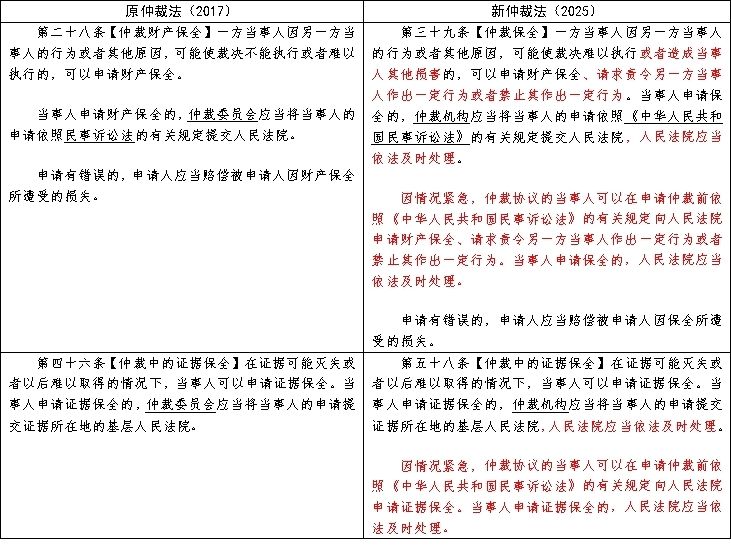
2. Improve the preservation system of arbitration


undefined

The new law has improved the preservation system of arbitration, specifically:


①Formally establish the behavioral preservation system;


②Clarify the systems of pre-arbitration property preservation, behavioral preservation, and evidence preservation.。


2.1. Formally establish the behavioral preservation system


The behavioral preservation system is an important remedy system in China's civil litigation and arbitration. Parties may apply to the court to request that the respondent perform or refrain from performing certain acts (including fulfilling obligations, ceasing infringement, etc.) before the judgment or ruling in the case is made and takes effect, in order to avoid the legitimate rights and interests of the applicant suffering irreparable harm.


In the past, China's arbitration preservation system only included property preservation and evidence preservation, without covering behavioral preservation. This made it difficult for parties to apply in arbitration for preventive remedies such as requesting the respondent to cease infringement, which could be initiated in litigation. Targeting typical areas like intellectual property disputes (where there is a greater urgency to stop infringing acts), the Supreme People's Court issued the Provisions on Several Issues Concerning the Application of Law in the Review of Cases Involving Behavioral Preservation in Intellectual Property Disputes in 2018, which made provisions on behavioral preservation in such arbitration cases.


The new law incorporates behavioral preservation into the scope of arbitration preservation, providing a legal basis for behavioral preservation in arbitration. For parties who need to promptly stop losses and prevent the expansion of damages, this provides very important support.


2.2. The new law clearly stipulates the systems of "pre-arbitration" property preservation, behavioral preservation, and evidence preservation.


The original Arbitration Law only stipulated preservation measures "during arbitration," meaning parties could only apply for preservation after the arbitration case was filed, with the application documents transmitted by the arbitration institution to the competent court. The new law grants parties the right to directly apply for preservation with the competent court before the arbitration case is filed. This revision is also connected with Article 104, Paragraph 1 of the Civil Procedure Law of the People's Republic of China, which states: "Interested parties, in urgent situations where failing to immediately apply for preservation would cause irreparable damage to their legitimate rights and interests, may apply to the people's court with jurisdiction over the location of the property to be preserved, the domicile of the respondent, or the case itself for preservation measures before initiating litigation or applying for arbitration..."


3. Determine the methods of service in arbitration


图片


In practice, the rules of various arbitration institutions mostly stipulate specific methods of service, including entrusted service, notarized service, electronic service, etc. However, as the original Arbitration Law did not explicitly recognize arbitration rules as the basis for service, parties often claim that the arbitration procedure violates statutory procedures on the grounds that the service procedure of arbitration documents does not comply with the provisions of the Civil Procedure Law of the People's Republic of China, and apply to the court to set aside or refuse enforcement of the arbitral award. To address this, the Supreme People's Court responded to practical pain points by issuing in 2018 the Provisions of the Supreme People's Court on Several Issues Concerning the Handling of Cases of Enforcement of Arbitral Awards by People's Courts, in which Article 14, Paragraph 2 stipulates: "...When the arbitral tribunal serves arbitration legal documents in accordance with the Arbitration Law, arbitration rules, or the manner agreed upon by the parties, if a party claims that it does not comply with the relevant provisions of the Civil Procedure Law on service, the people's court shall not support such claim."


This revision of the new law has clarified the basic principle of giving priority to party autonomy and being based on arbitration rules, which provides a legislative basis for the arbitration service system. In this regard, for fellow lawyers, it is recommended that if necessary, to specify the service methods when drafting the arbitration agreement; because according to the rules of most arbitration institutions, receiving a text message is generally considered as service, making it easy to miss the text message or fall into a passive situation.


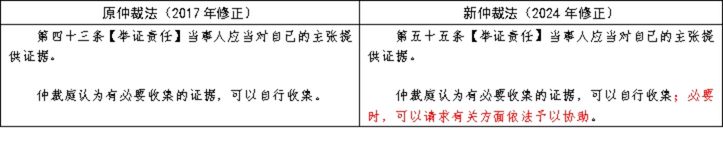
4. Expansion of the arbitral tribunal's right to obtain evidence: Requesting assistance


undefined

When a party is unable to collect relevant evidence due to objective reasons, it may apply to the arbitrator for investigation and evidence collection. However, when the arbitral tribunal issues a letter of assistance in investigation to a third party requesting cooperation in evidence collection, the decision of the arbitral tribunal is not legally binding on the third party, making it difficult to actually carry out evidence collection in arbitration.


To address this dilemma, judicial documents have been successively issued in places such as Shanghai and Guangdong, establishing the "arbitration investigation order" system. It stipulates that when the arbitral tribunal has difficulty in investigating and collecting evidence on its own, it can apply to the people's court for an investigation order through the arbitration institution. For example: ① On December 1, 2023, the Shanghai High People's Court issued the Measures (Trial) on Issuing Investigation Orders to Assist Arbitration in Investigation and Evidence Collection; ② In June 2025, the Guangdong High People's Court issued the Measures (Trial) on Issuing Investigation Orders to Assist Commercial Arbitration Institutions in Investigation and Evidence Collection, allowing local courts to assist the arbitral tribunal in investigation and evidence collection in the form of an investigation order.


Internationally, Article 27 of the UNCITRAL Model Law on International Commercial Arbitration (the UNCITRAL Model Law) also contains similar provisions: the arbitral tribunal, or a party with the arbitral tribunal's consent, may request a competent court to assist in the collection of evidence.


The new law clarifies that the arbitral tribunal may request relevant parties to assist in investigation and evidence collection in accordance with the law, which helps resolve obstacles in arbitration evidence collection and is more conducive to parties and the arbitral tribunal in ascertaining the facts of the case. However, this revision does not specify the competent court as the subject or the specific form. It is hoped that reference can be made to the practical experience of investigation orders issued by courts in Shanghai, Guangdong and other places mentioned above, and further provisions can be made in relevant judicial interpretations to ensure implementation.


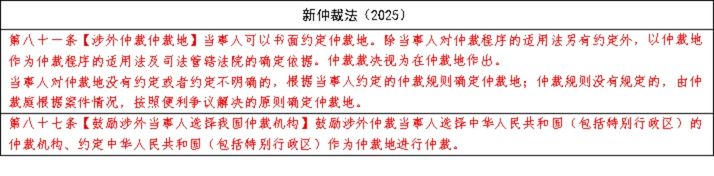
5. Formally introduce the system of arbitration seat for foreign-related arbitration.


undefined


The new law introduces the system of arbitration seat from international commercial arbitration in the section on foreign-related arbitration and establishes the concept of "arbitration seat" at the legislative level. The original Arbitration Law did not explicitly define the concept of arbitration seat, and in practice, many people tend to confuse "arbitration seat" with the location of the arbitration institution.


In international commercial arbitration, the place of hearing is the physical/geographical location where the parties and their agents actually attend the hearing, which generally has no legal significance; the location of the arbitration institution is the registered or office location of the arbitration institution.

Regarding the arbitration seat, it is a legal concept, and its specific connotations are as follows:


A.The arbitration seat determines the nationality (or jurisdiction of origin) of the award; while the nationality (or jurisdiction of origin) of the award affects the enforcement of the award.

B.The law of the seat of arbitration is the applicable law for arbitration proceedings; when the parties have not specially agreed, the basis for determining the validity of the arbitration proceedings is the law of the seat of arbitration.

C.The arbitration seat determines the judicial jurisdiction, that is, the court of the seat of arbitration usually has jurisdiction to set aside the award.

D.The arbitration seat is an important connecting or consideration factor for the applicable law of the arbitration agreement.


The new law's improvement of the "arbitration seat" system further clarifies the basis for determining the nationality of arbitral awards, resolves the issue of unclear provisions regarding the judicial review jurisdiction over awards, helps to encourage more foreign parties to choose China as the seat of arbitration, and is also conducive to enhancing the competitiveness of China's international arbitration.


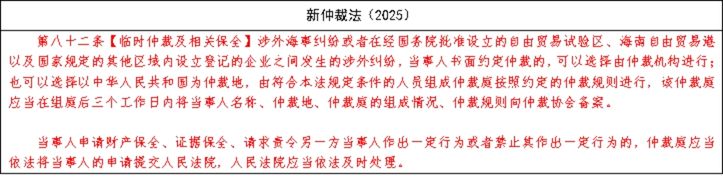
6. (Ad Hoc Arbitration)


undefined


The inclusion of ad hoc arbitration is one of the highlights of the revision of the new law, and China has since formally established a parallel model of "institutional arbitration" and "ad hoc arbitration" at the legislative level.


Ad Hoc originates from Latin, meaning "for this", extended to mean "for a particular purpose", and is generally translated into Chinese as "set up for a certain purpose, special, temporary". Looking back at history, arbitration developed from ad hoc arbitration, with the earliest form being ad hoc arbitration among merchants in the same industry. The international legal basis for the establishment of ad hoc arbitration comes from the 1958 United Nations Convention on the Recognition and Enforcement of Foreign Arbitral Awards (i.e., the New York Convention). China acceded to the New York Convention in December 1986 and recognizes and enforces foreign ad hoc arbitral awards in accordance with the law, but domestic legislation excluded ad hoc arbitration, with no provision for an ad hoc arbitration system until the original Arbitration Law (2017).


However, in recent years, the Supreme People's Court and arbitration institutions across the country have gradually explored related systems. For example, in 2016, the Supreme People's Court issued the "Opinions of the Supreme People's Court on Providing Judicial Guarantee for the Construction of Pilot Free Trade Zones," which first tentatively recognized the validity of ad hoc arbitration agreements between enterprises in pilot free trade zones, proposing the "three specific" prerequisites—specific location, specific arbitration rules, and specific personnel—allowing enterprises registered in the pilot free trade zones to conduct ad hoc arbitration at a specific location, in accordance with specific rules, and by an arbitral tribunal composed of specific personnel. This judicial document sowed the seeds for the development of ad hoc arbitration domestically, but the ad hoc arbitration system still had not officially obtained legislative authorization.


The Shenzhen Court of International Arbitration implemented the Procedural Guidelines of the Shenzhen Court of International Arbitration on the Application of the UNCITRAL Arbitration Rules on December 1, 2016. These guidelines stipulate that arbitration parties may choose to adopt the UNCITRAL Arbitration Rules, specifying that unless the arbitral tribunal decides otherwise, if the parties have not agreed on the seat of arbitration, the seat shall be Hong Kong. By opting for the approach of designating "Hong Kong as the seat of arbitration," this guideline leads to the arbitral award being deemed to be made in the Hong Kong Special Administrative Region, subject to Hong Kong law, and thus applying ad hoc arbitration.


Relevant explorations also include the Working Rules (Trial) on Assisting Ad Hoc Arbitration of the Hainan International Arbitration Court and the Rules on Ad Hoc Arbitration of the Shanghai Arbitration Association, among others. Various localities have gradually clarified and stipulated the scope of application, procedural rules, and filing mechanisms for ad hoc arbitration, marking that explorations at the local level in China have initially taken shape.


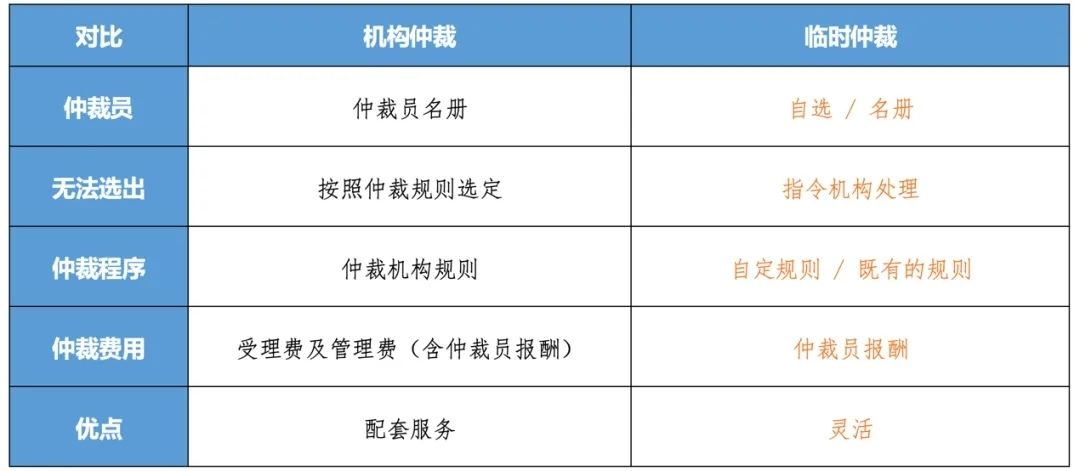
As for ad hoc arbitration, specifically, it emphasizes party autonomy, allowing parties to autonomously negotiate and formulate procedural rules (including the composition of the arbitral tribunal, selection of arbitrators, etc.). It offers greater flexibility and higher efficiency, enabling it to better meet the needs of the parties in specific cases. Moreover, ad hoc arbitration does not require payment of case acceptance fees and management fees to arbitration institutions.


Comparison: Institutional Arbitration / Ad Hoc Arbitration


undefined


This revision of the new law confirms the ad hoc arbitration system. While gradually embracing international arbitration practices, it adopts a cautious attitude based on risk prevention and control, limiting the scope of applicable cases to foreign-related maritime disputes and foreign-related disputes between enterprises registered in areas such as pilot free trade zones. Secondly, if choosing ad hoc arbitration, the parties should select China as the seat of arbitration, members of the arbitral tribunal should meet the conditions stipulated by the new law, and the filing with the arbitration association should be completed within three working days after the formation of the tribunal. Moreover, the new law clarifies that ad hoc arbitration is applicable to the preservation system.


Ad hoc arbitration is still an emerging practice in China, and without supervision by a permanent institution, arbitrators have considerable discretionary power, which will place higher demands on the quality of arbitrators. In such circumstances, without corresponding laws, mature systems, extremely high professional standards, and ethical integrity, it is highly likely to lead to situations such as abuse of power by arbitrators or false arbitration, which may even harm the interests of third parties and severely undermine the credibility of arbitration. To regulate the abuse of power by arbitrators, the Sixth Amendment to the Criminal Law in 2006 added the crime of "malicious arbitration," which stipulates as follows: "Persons who are legally responsible for arbitration duties, if intentionally violating facts and laws to make malicious rulings in arbitration activities, and the circumstances are serious, shall be sentenced to fixed-term imprisonment of not more than three years or criminal detention; if the circumstances are especially serious, they shall be sentenced to fixed-term imprisonment of not less than three years but not more than seven years." Upon retrieval, there are few relevant conviction cases, and some cases involve parties applying to set aside arbitral awards on the grounds of "malicious arbitration." In view of this, it is believed that with the gradual development of arbitration, China should have further legislative and judicial regulations on the corresponding regulation of arbitrators.


7.Shorten the time limit for applying to set aside an arbitral award: from 6 months to 3 months


undefined


The original Arbitration Law stipulated a six-month time limit for applying to set aside an arbitral award, which the new law revises to three months to align with the UNCITRAL Model Law on International Commercial Arbitration. This revision aligns with international standards, helping to enhance the certainty and stability of arbitral awards. Conversely, it increases the costs and raises the requirements for parties and their representatives in the work of applying to set aside awards.


 FOUR

Conclusion: Opportunities and challenges coexist


The promulgation of the new Arbitration Law is of great significance to the internationalization and specialization of China's arbitration system. Currently, there are more than 280 arbitration institutions established nationwide, with a cumulative total of over 5 million arbitration cases handled and the total amount involved in these cases exceeding 9 trillion yuan. And in 2024, the number of foreign-related arbitration cases handled nationwide reached 4,000, with the amount involved in foreign-related cases approaching 200 billion yuan. Only by closely following the new laws and regulations and continuously improving their professional capabilities can lawyers provide parties with more efficient and reliable dispute resolution guarantees.


In the interactive session at the end of the sharing meeting, lawyers, drawing on their own practical experience, engaged in lively discussions on the theme of this session. Finally, Lawyer Zheng Tao, Director of the Company Committee of Chenggong and Director of Chenggong Associated Law Firm, summarized that the development of the domestic arbitration cause is very unbalanced and far from optimistic. Arbitration institutions in first-tier cities have high incomes and are overwhelmed with work, leading to indefinite extension of the trial period, while arbitration institutions in economically underdeveloped areas are deserted and on the verge of closure. This revision of the Arbitration Law has not yet addressed several aspects: First, after an award is set aside or not enforced by a court, should the substantial arbitration fees be refunded? Second, the issue of supervision over the use of arbitration funds. Additionally, it is suggested to add a delivery method in the arbitration agreement, which can be the same as the non-litigation delivery method agreed upon in a certain clause of the contract.

Group photo for souvenir 


undefined

Lecturer of This Session


undefined