There are boundaries for commercial appointments, and only by clarifying rights and liabilities can peace of mind be secured. In this dispute over the registration of legal representative qualification, Lawyer Liu Ji from Guangdong Chenggong Law Firm responded to the lawsuit with prudence throughout the process. After judicial trials at both the first and second instance, he proceeded steadily with solid legal grounds, and ultimately achieved an outstanding outcome of full victory in both trials, successfully removing the registration of the involved legal representative and relevant appointment qualifications. This victory not only efficiently breaks the predicament of identity binding and avoids potential legal risks, but also demonstrates the protection of law for the legitimate rights and interests of commercial entities, serving as an excellent reference model for handling similar commercial registration disputes.
ONE Service Case Information
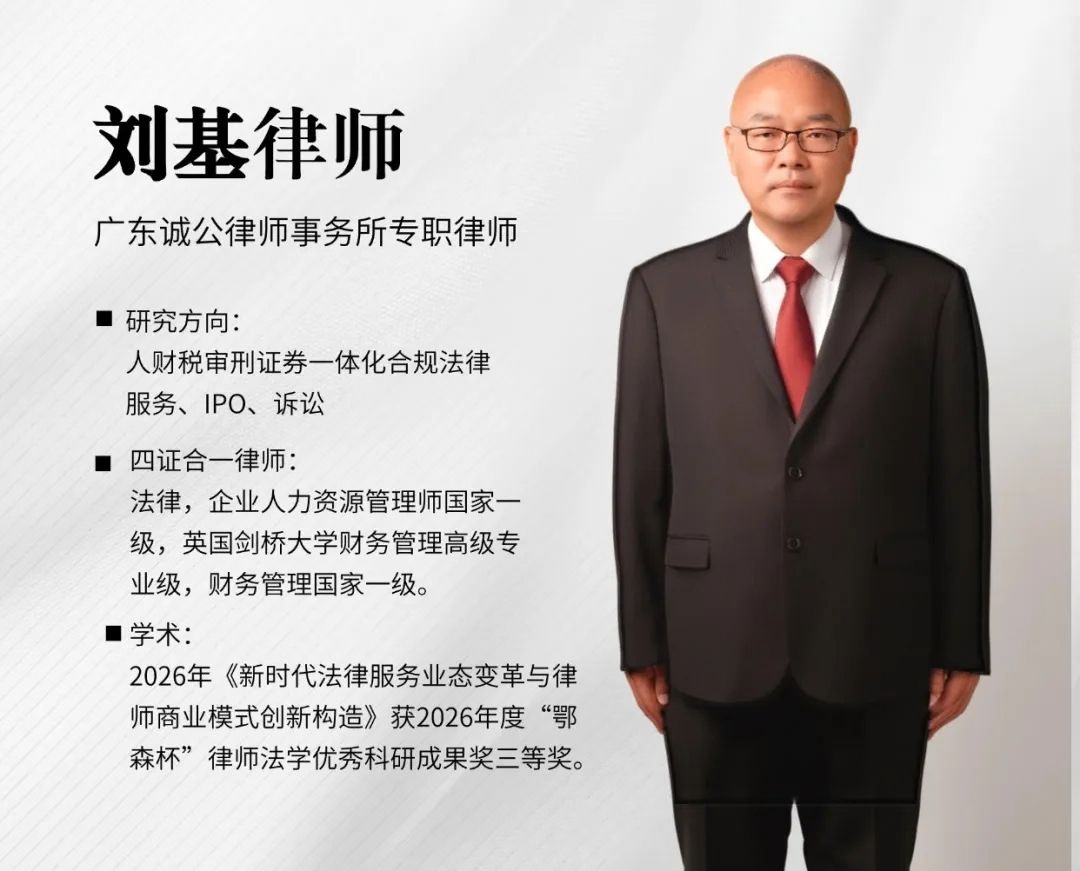
Serving Lawyer: Liu Ji
Affiliated Law Firm: Guangdong Chenggong Law Firm
Service Area: General Equipment Manufacturing Industry
Case Closing Date: March 2026
TWO Case Summary
On August 29, 2022, the plaintiff joined the defendant company and served as its legal representative, executive director and person in charge of finance, with the industrial and commercial registration completed. However, the plaintiff was rarely involved in the company's management in practice. On June 25, 2024, the plaintiff resigned from the defendant company and ceased to hold any positions. After resignation, the plaintiff repeatedly requested the defendant to complete the change registration of legal representative in writing, via WeChat and other means, yet the defendant refused to cooperate.
The core issues of the dispute are as follows: 1. Is the claim actionable? 2. Under what circumstances may judicial authorities intervene to rule on the removal of registration? 3. What is the procedure to apply for change registration where the court orders such removal? 4. Other matters.
The first instance trial was held at a district people’s court in Longyan City on September 26, 2025. The court ruled that the defendant shall file an application with the Administration for Market Regulation to complete formalities for removal and change registration of the plaintiff’s positions as legal representative, executive director and person in charge of finance after the judgment takes effect. The defendant filed an appeal, and the second instance hearing was held at Longyan Intermediate People’s Court on March 31, 2026.
The plaintiff’s argument: Pursuant to Article 10 of the new Company Law, the plaintiff’s status as legal representative terminates automatically upon resignation, and the defendant shall complete the change registration within thirty days. The defendant’s failure to complete registration in accordance with the law violates the Company Law, Regulations on the Administration of Company Registration and other relevant provisions and infringes upon the plaintiff’s legitimate rights and interests. Therefore, the plaintiff instituted proceedings before the competent court, requesting an order for the defendant to remove the plaintiff’s registered information as the legal representative.
Case Outcome: The first instance court upheld the removal application; the judgment of the second instance affirmed the original ruling.
THREE Service Highlights
1、Lawyer’s Handling Process
Case Acceptance and Fact Verification: The lawyer first learns core facts from the client, such as the date of resignation, resignation procedures and the company’s cooperation status. Meanwhile, the lawyer retrieves corporate internal registration files, articles of association and other documents to confirm the client’s position, corporate governance structure and internal decision-making procedures.
Sorting out Internal Remedy Procedures: Assist the client to preserve resignation evidence, including delivery records of written resignation letters, emails, correspondence and receipt vouchers for communications with the company regarding change of registration; collect evidence of corporate governance deadlock and impossibility of convening shareholders’ meetings to prove that all internal remedies have been exhausted.
Formulation of Litigation Strategy: Determine claims based on case facts, such as requesting confirmation of the effectiveness of resignation and ordering the company to remove the relevant registration. Meanwhile, identify the competent court (the company’s domicile), prepare the complaint and evidence list, and clarify the legal basis for core claims.
Court Hearing and Enforcement Follow-up: During the hearing, present and cross-examine evidence focusing on key points including "loss of substantial connection" and "exhaustion of internal remedies". After winning the case, promptly apply to the court for compulsory enforcement and coordinate with the registration authority to complete the removal registration via the National Enterprise Credit Information Publicity System.
2、Handling Difficulties
Breaking through corporate governance deadlock: The company’s shareholders fail to respond and shareholders’ meetings cannot be convened. The key difficulty lies in how to prove that "all internal remedies have been exhausted", as well as how to prove "all external remedies have been exhausted".
Dilemma arising from the absence of a new legal representative: Where the company fails to elect a new legal representative, it is necessary to rely on Article 10 of the new Company Law, which stipulates that mandatory removal of the original registration may be ordered if no new candidate is determined within 30 days, to persuade the court to directly rule for such removal without requiring cooperation from a newly appointed candidate.
3、Identification of Key Legal Issues
Substantial Connection Assessment: The court primarily examines whether the client still maintains a labor relationship, shareholder status or substantial operational and management connection with the company. Where the client has resigned, is not a company shareholder and does not participate in business operations, the court will generally find that such connection has been terminated.
Exhaustion of Internal Remedy Procedures: Prove that the client has fulfilled the obligation of notice, including delivering resignation notices to the company and proposing to convene shareholders’ meetings. Judicial intervention is necessary when corporate governance failure renders change through internal procedures impossible.
Legality of Registration Removal: Focus on examining whether prohibited circumstances such as malicious evasion of debts exist. If the company is not in bankruptcy or major litigation proceedings, registration removal generally will not prejudice creditors’ interests or transaction order.
4、Legal Risks
Retroactive Liability Risk: Registration removal only addresses liability arising from the status in the future. If the company incurred illegal acts or debts during the period when the client served as the legal representative, the client may still bear corresponding liabilities, and such risks shall be notified to the client in advance.
Risk of Litigation Failure: Where the client still holds corporate equity, actually participates in business operations, or fails to fully complete internal remedy procedures, the court may dismiss the claim on the ground that "the matter falls within the scope of corporate autonomy".
Enforcement Coordination Risk: Some registration authorities differ in their cooperation with court notices for assistance in enforcement. Advance communication with registration authorities is required to ensure the smooth completion of registration removal.
5、Application of Law
Article 10 of the new Company Law: It clarifies that the resignation of a legal representative takes effect immediately. The company shall appoint a new candidate within 30 days; otherwise, the original registration may be mandatorily removed.
Article 23 of the Measures for the Implementation of Company Registration Administration: It stipulates that after the court serves the notice of assistance in enforcement, the registration authority shall remove the relevant information through the public notice system.
Judicial Adjudication Rules: Identify supporting precedents for the judge’s reference.
6、Response Strategies
Evidence Preservation Strategy: Retain evidence of resignation and demand notices through multiple channels such as emails, EMS delivery and WeChat service to prove the fact of resignation.
Timing of Litigation: File a lawsuit with the court in a timely manner to apply for registration removal when the company is operating normally.
Enforcement Coordination Strategy: Promptly apply for compulsory enforcement after winning the case, and submit the effective court judgment and notice of assistance in enforcement to the registration authority. Where necessary, coordinate through the court to facilitate the registration change.
FOUR
Practical Significance
1、Practical Significance and Innovative Practices of the Case
The core practical significance of such cases lies in breaking the traditional adjudication logic of "priority of registration appearance" and establishing the adjudication standard of "substantial connection review". It clarifies that judicial intervention for registration removal is available where the legal representative has lost substantial interest connection with the company and exhausted internal remedies without success, filling the institutional gap for remedies for nominal legal representatives. The innovative practices are reflected in the following aspects: first, to concretize the "appointment dependency" rule under Article 10 of the new Company Law, adopting the three elements of "no equity holding, no operational participation and no remuneration" to identify the fact of nominal appointment; second, to clarify the legal effect of "simultaneity of resignation", confirming that resignation from the position constitutes resignation of the legal representative, and no separate resolution of the company is required; third, to break the restriction of "no removal without a successor", directly ordering registration removal where the company delays the process in bad faith.
2、Practical Outcomes and Replicable and Promotable Value
The trial of the case effectively resolves the predicament of "the person has left yet the status remains", providing a clear judicial remedy path for nominal legal representatives and preventing them from bearing unnecessary legal liabilities arising from the company’s operational risks. Meanwhile, it compels companies to standardize internal governance and complete change registration in a timely manner, maintaining the stability of market transaction order. Its adjudication logic is widely replicable. Courts across regions may apply the standard of "substantial connection review plus exhaustion of internal remedies" to unify the adjudication criteria for similar cases and reduce inconsistent judgments in like cases.
Lawyer Profile